.svg)


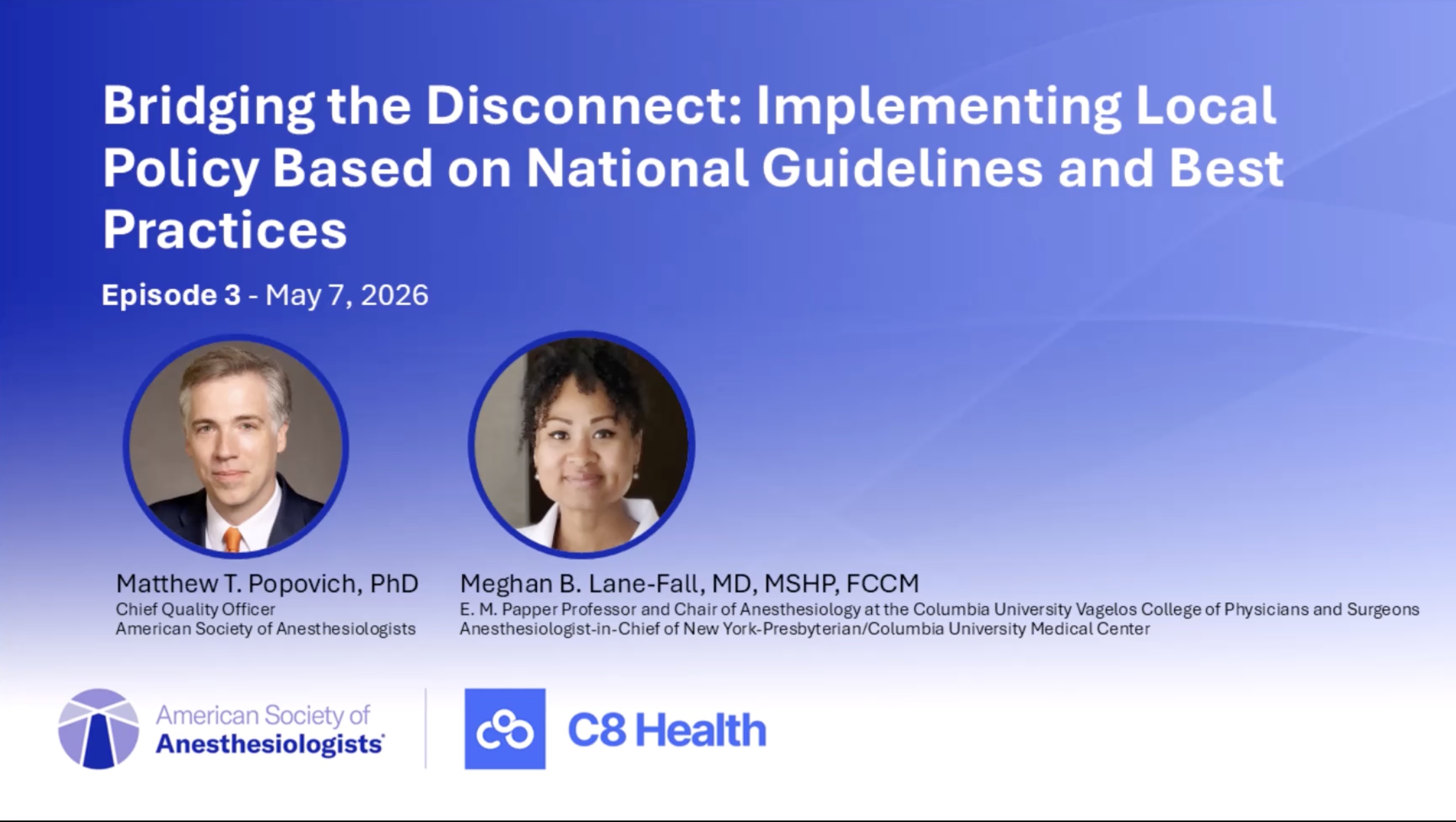
"Bridging the Disconnect” is a four-part interview series collaboratively produced by the American Society of Anesthesiologists and C8 Health. Hosted by Matthew T. Popovich, PhD, Chief Quality Officer of the American Society of Anesthesiologists, the series runs semi-weekly from July to August 2026 with a special guest offering fresh insights with each edition.
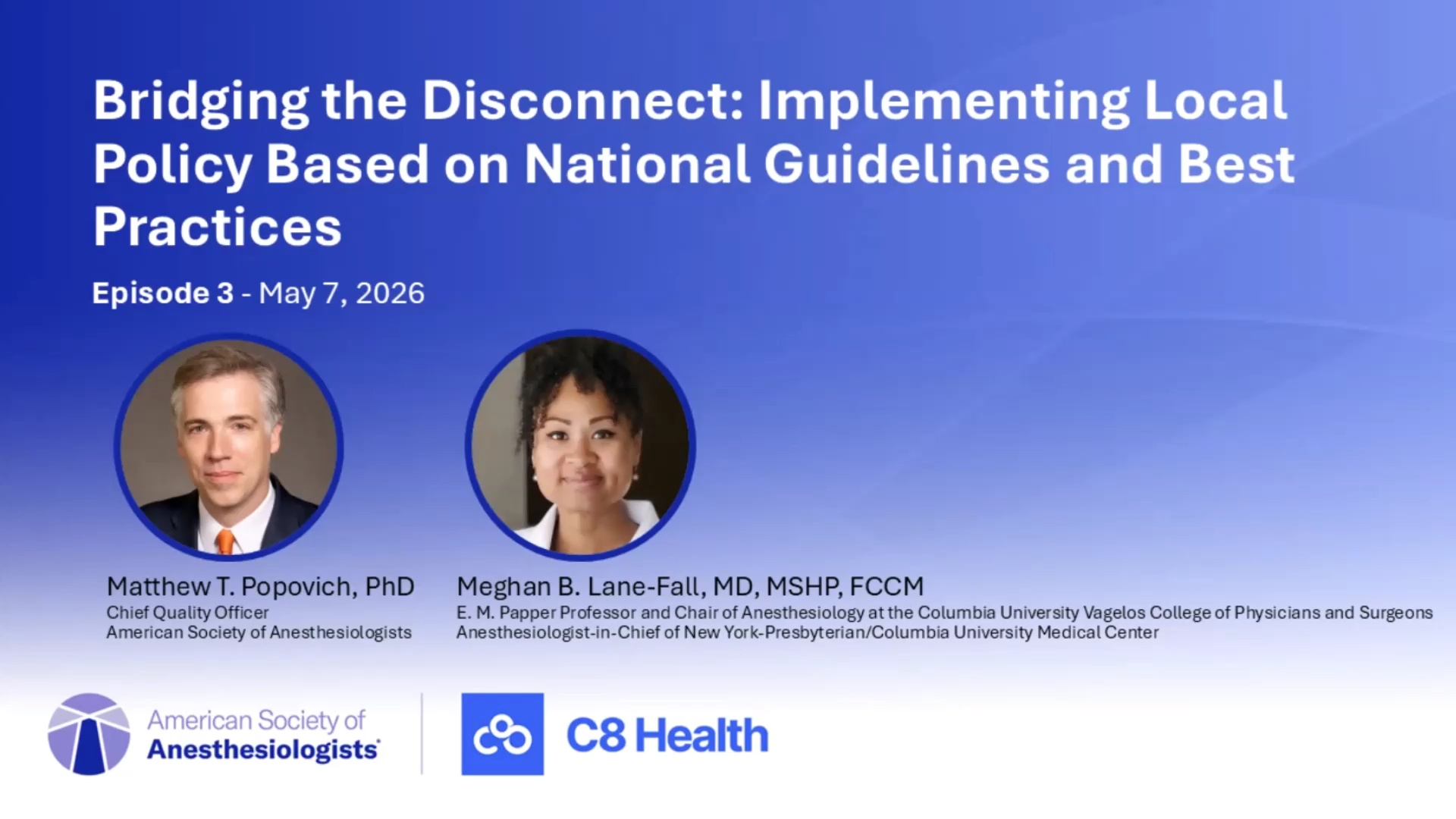
Dr. Meghan B. Lane-Fall, MD, MSHP, FCCM is an accomplished anesthesiologist. She’s an E.M. Papper Professor and Chair of Anesthesiology at the Columbia University Vagelos College of Physicians and Surgeons, as well as the Anesthesiologist-in-Chief of New York-Presbyterian/Columbia University Medical Center.
She’s also an implementation scientist.
What does that mean? According to Dr. Lane-Fall, implementation science is “a social science that’s really concerned with how to achieve changes in practice related to evidence-based care.” “We know what the right thing is to do, but it’s not always the easy thing to do. And so implementation science is focused on reliable strategies to get people and systems to do the things that we want them to do.”
It’s a useful perspective when addressing the gaps between established best practices and access to those best practices at the moment of care.
The importance of “local context”
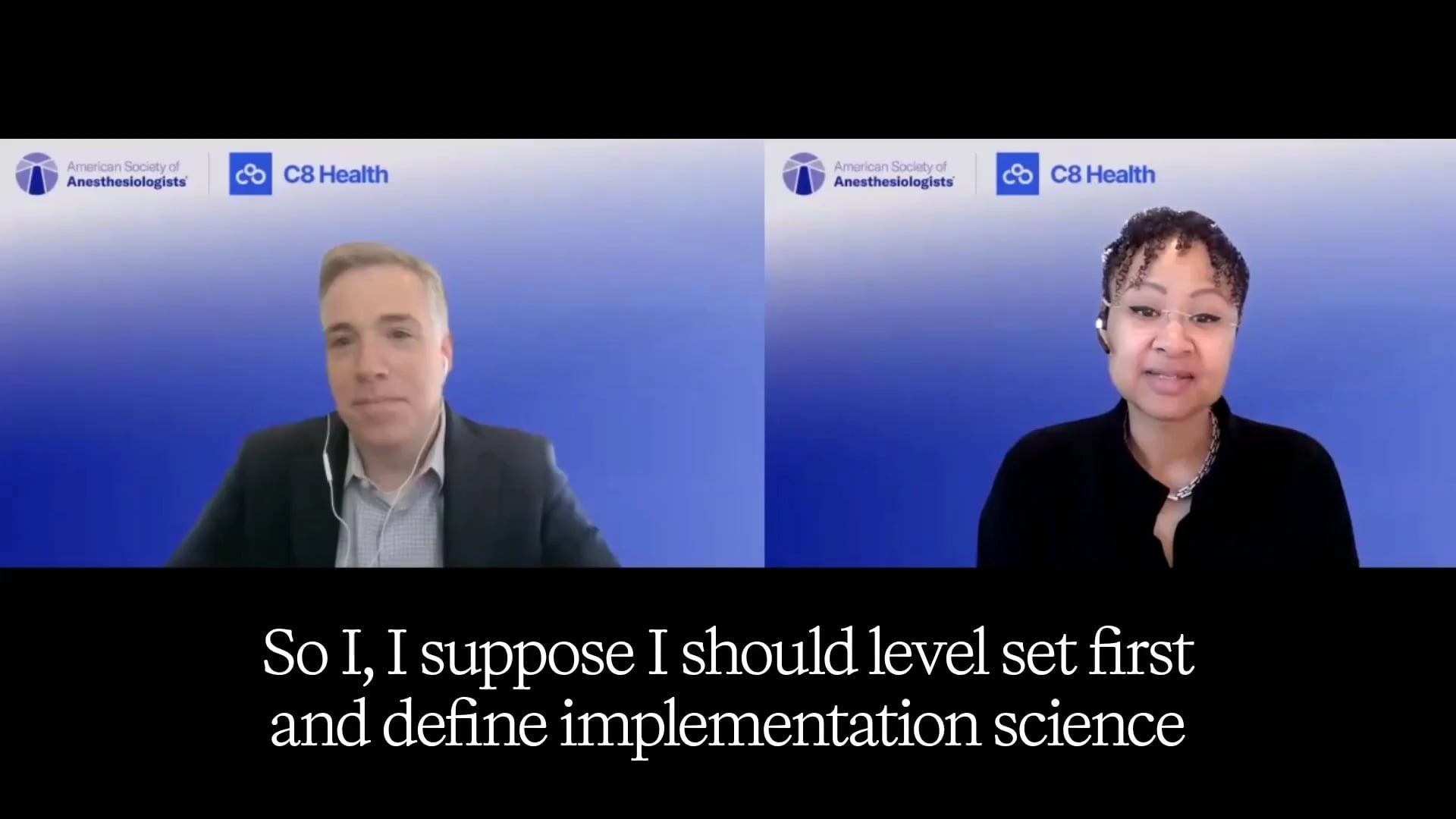
Dr. Lane-Fall isn’t the first clinician to experience friction between national guidelines and local policy. In the first two episodes of “Bridging the Disconnect,” host Matthew T. Popovich, PhD, discussed this very issue with MetroHealth’s Dr. Luis Tollinche and UCLA’s Dr. Johnathan Pregler. But Dr. Lane-Fall’s role as an implementation scientist gives her a unique perspective on the workflow challenges that impact clinicians within and outside of her department.
“A big part of the work that I do is trying to understand local context,” she said. In practice, that means leaning on the tools she uses as a scientist: careful observation, thoughtful discussions, and generally paying attention to the things that get missed. That’s how she came to understand that the issues with updating guidelines “really have to do with workflow.”
For example, it’s easy enough to find the document you’re looking for when you’re sitting at a desk in front of a computer in a more relaxed setting. But what about when you’re in the operating room standing over a patient with quickly changing physiologic parameters? “We work in very time-pressured settings,” she explained, and new processes need to account for those settings.
The solution, though easier said than done, is to align those existing workflows with evidence “so we make the easy thing to do the right thing to do.”
C8 Health makes it a snap for anesthesiology departments to align workflows and increase care consistency. Find out how to implement evidence-based practices and support better patient outcomes with an AI-powered shared playbook here.
No one works alone
A common theme from all three episodes of “Bridging the Disconnect” so far is the importance of collaboration; as Dr. Lane-Fall put it, “None of the work that we do is done in a vacuum.” Most departments in a hospital setting have similar priorities, since they all aim to minimize harm and deliver outstanding patient care when you zoom out to look at the big picture. Sometimes, as Dr. Lane-Falll explained, “Priorities are ordered in a different way.”
In other words, clinicians need to align their priorities with those of all stakeholders, including surgeons, nurses, managers, and policy makers outside of their immediate teams. That takes a dedication to communication. For example, “a lot of information can be lost” in the handoff stage between the operating room and ICU as care shifts from anesthesiologists and surgical teams to post-op teams.
One of Dr. Lane-Fall’s greatest success stories is combining implementation science with systems engineering and human factors to standardize that handoff process. By creating the proper expectations for how the different teams should interact with each other, she made what was once a messy transition into something “easy, streamlined, predictable.”
C8 Health customers have seen similar gains from standardizing workflows. MetroHealth's anesthesia team took ERAS compliance from 65% to 88% in five months after putting shared protocols on the platform.
How C8 Health Bridges the Disconnect
According to Dr. Lane-Fall, bridging the disconnect between policy and practice is a shared workflow issue that medical teams must navigate together. Clinicians can’t get on the same page without a shared playbook.
With an intuitive app, speedy access to hospital-approved information even during time-sensitive settings, and powerful search functionality, C8 Health is that playbook. Today, 94% of clinicians with access to the platform consult C8 Health before ERAS cases, and clinicians report finding the guidance they need 5.9x faster. By making the latest evidence available in practice, clinicians can prevent the missed steps that lead to costly errors. Learn more about C8 Health, the clinical performance platform trusted by more than 150 institutions, here.
You can watch the full interview in the video at the top of this page. C8 Health would like to thank Dr. Meghan B. Lane-Fall, Dr. Matthew T. Popovich, and the American Society of Anesthesiologists for their valuable time and perspective. You can learn more about the ASA at https://www.asahq.org.